
Here’s How to Stay Safe with TOPCYBER21 (and then some)
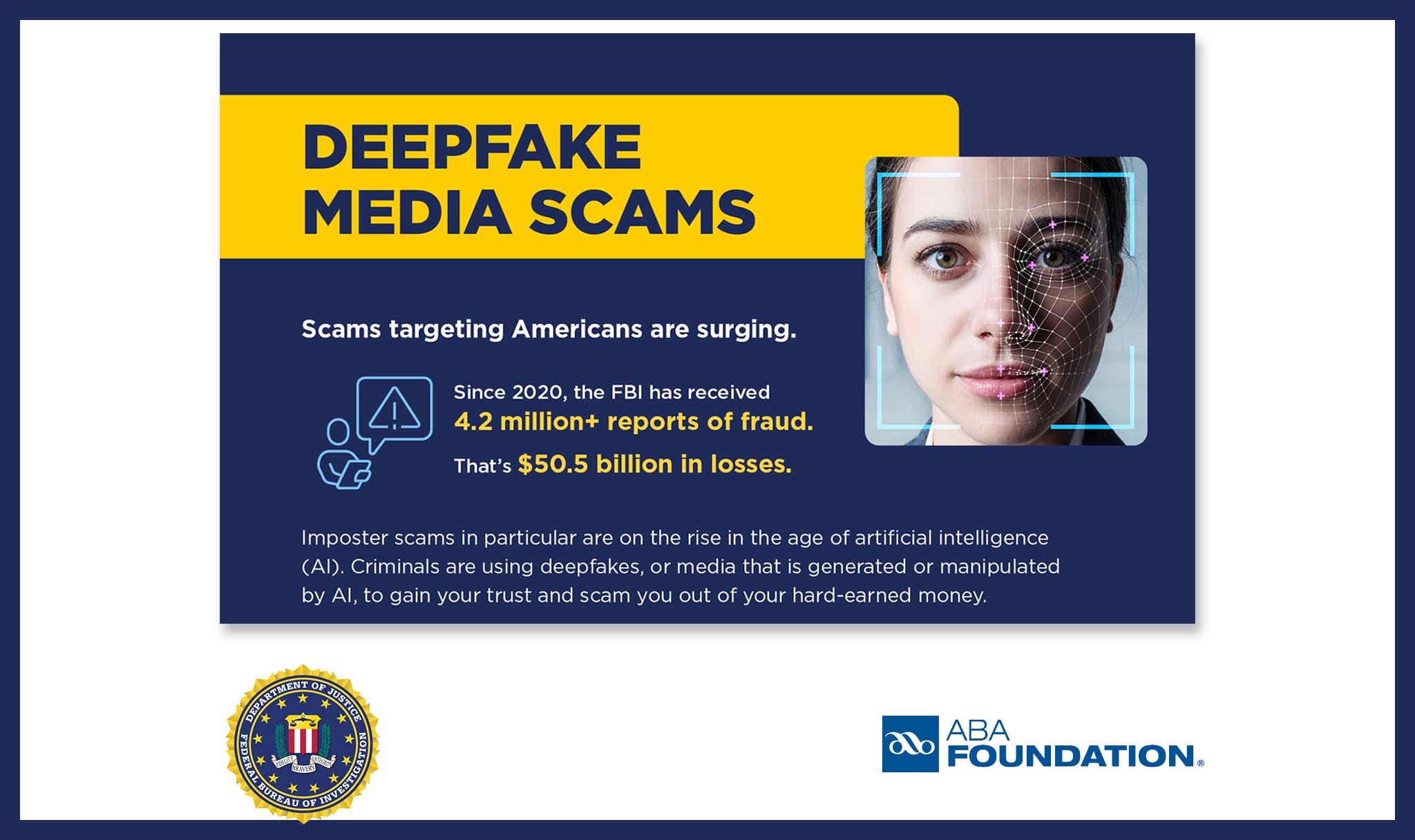
We’ve all seen the headlines (and here’s the latest Sept 3, 2025) chilling chapter, including an infographic from American Banker’s Association aimed a educating the public about the growing threat of deepfake scams.
According to the FBI, more than 4.2 million fraud reports have been filed since 2020, resulting in over $50.5 billion in losses, with a growing portion stemming from deepfake scams – AI-generated or manipulated media, including images, video and audio, used to impersonate trusted individuals – posing as loved ones, government officials, law enforcement personnel or even celebrities, often using fear and urgency to convince victims to send money or share sensitive information.
Criminals are already using these tools to impersonate executives on Zoom calls, trick finance staff with voice messages, and pressure employees into handing over credentials or wiring funds.
The problem? Trust cues we’ve relied on—like a familiar face on a video call or a familiar voice on the phone—are no longer reliable.
The deepfake threat is here. And it’s only getting better at deception!
The Growing Risk
AI has made impersonation cheap, fast, and frighteningly convincing:
- Fake executive calls: Fraudsters can simulate a CEO’s voice to order urgent wire transfers.
- Synthetic video meetings: Attackers can pose as leadership in a Teams or Zoom session.
- Brand/domain spoofs: AI-generated phishing emails, text messages, and lookalike websites trick employees into believing they’re legitimate.
The FBI and IC3 have issued multiple advisories: organizations must stop relying solely on human “gut checks” to spot a fake and start building formal safeguards into daily workflows.
TOPCYBER21 (TC21) Managed “Defense-in-Depth” Already Mitigates This Threat
The good news: TC21 was designed to get ahead of evolving threats—and many of its existing best practices already reduce the risk of deepfake-enabled attacks:
- Inbound Email Phishing Protection: Detects brand impersonations, look-alike domains, and fraudulent email attempts before they hit inboxes.
- Security Awareness Training:Builds the reflex to pause before acting on urgent or emotional requests—key to resisting social engineering.
- Password Management & Zero Trust: Strong credential hygiene and application control limit fallout even if an impersonation trick succeeds.
- Endpoint & DNS Protections: Block many follow-on malware or credential harvesting tactics tied to impersonation campaigns.
- Policy, Risk, and Incident Response Practices: Provide a governance backbone for formalizing verification steps and documenting response to suspected impersonation attempts.
Additional Safeguards Leaders Should Add Now
Since risk evolves constantly, protection measures must advance in step and in kind. While TC21 is designed to evolve, new threats posed by the deepfake era mandate extra safeguards. Here’s a short list of recommendations to add to your current security defenses:
- Phishing-Resistant MFA (FIDO2/WebAuthn): Especially for executives, admins, and finance approvers. These physical keys prevent most account takeover even if credentials are phished.
- Verification Protocols: Out-of-band callbacks to a known number plus a rotating “code phrase” before money, credentials, or sensitive files move—no exceptions.
- Deepfake-Aware IR Playbook: Add procedures for suspected synthetic voice/video scenarios, including escalation and evidence preservation.
- Secure Meeting Practices: Require meeting codes and simple “liveness checks” (e.g., read a code aloud) before approvals in Zoom/Teams.
- Brand & Executive Monitoring: Extend monitoring beyond email to cover social platforms, fake domains, and impersonation sites.
- Finance Guardrails: Enforce dual approval, thresholds, and time-delayed holds on wire transfers or vendor changes.
The Bottom Line
Deepfakes are not a future problem—they’re a today problem. Organizations that treat this purely as a “tech issue” will fall behind.
This is about leadership, governance, and habit.
Your #CYBERsane Next Step
The habits are real. The risks are rising. And doing nothing? That’s not a strategy. Take the #CYBERsane next step now – while you still have a choice.
About the Author:
Matt Tankersley, CISSP is a US Navy combat veteran and the Founder & CEO of TechOnPurpose. Matt is recognized as an innovator with over 35 years of experience in Information Technology specifically in the areas of collaboration, cloud, security, and managed services. Recognizing the complexity, risk and blindsides that business owners face led Matt to create the TOPCYBER21™ Framework, which simplifies how organizations operationalize cybersecurity. Matt’s dedication to customer experience and unwavering belief that “Technology is at the Heart of Business today,” cast the foundation for our culture and simple operating philosophy: “We love what we do, who we do it with, and who we do it for.”
About TechOnPurpose:
Based in Austin, Texas, TechOnPurpose (“TOP”) delivers comprehensive managed IT and cybersecurity solutions to select clients globally. TOP’s approach to managed IT and cybersecurity continues to deliver simplified conversations and comprehensive, affordable solutions for our global customer family of Small & Medium Businesses and Non-Profits.


